How to Choose Your First Commander
One of the best things about Commander is that there’s a deck for everyone.
Do you want to summon massive creatures and smash face?
There’s a commander for that.
Want to cast spells nonstop and outsmart the table?
There’s a commander for that too.
Love Goblins? Zombies? Dragons? Elves? Weird combos? Pure chaos?
Commander has all of it.
But for brand new players, that freedom can also feel overwhelming fast.
There are thousands of legendary creatures in Magic, and trying to pick your very first commander can feel like standing in front of an all-you-can-eat buffet with no idea where to start.
The good news?
Choosing your first commander doesn’t need to be complicated.
You don’t need the “best” commander.
You don’t need the strongest deck.
And you definitely don’t need an expensive list full of rare cards.
What you do need is a commander that matches:
- Your personality
- Your playstyle
- Your experience level
- And most importantly…what you actually find fun
Because the best beginner commander is the one that makes you excited to sit down and play again.
First: Understand What Your Commander Actually Does
Your commander is the centerpiece of your entire deck.
Everything in your deck is built around that legendary creature.
Your commander:
- Determines your deck’s colors
- Influences your strategy
- Shapes how your deck wins games
- Gives your deck its identity
If your commander likes creating tokens, your deck probably focuses on tokens.
If your commander rewards casting spells, your deck will likely include lots of instants and sorceries.
Think of your commander as:
The “theme” of your deck
That’s why choosing the right one matters so much.
Don’t Choose Based on Power Alone
This is one of the biggest mistakes new players make.
A commander being “strong” does not automatically make it beginner friendly.
Some commanders:
- Require complicated sequencing
- Need deep rules knowledge
- Depend on combo lines
- Punish mistakes heavily
And honestly?
That can make learning Commander frustrating.
Your first deck should help you:
- Understand the game flow
- Learn interactions
- Build confidence
- Actually enjoy yourself
Simple does not mean weak.
In fact, many simple commanders are extremely powerful.
Start by Asking Yourself One Question
“What sounds fun to me?”
Not:
- “What’s top tier?”
- “What wins tournaments?”
- “What does everybody else play?”
What sounds fun to you?
Because Commander is a format built around expression and personality.
The Main Commander Playstyles
Most Commander decks fall into a few major playstyle categories.
Understanding these helps narrow down what kind of player you are.
Aggro – “I Want to Attack”
Aggro decks focus on:
- Creatures
- Combat
- Pressure
- Fast damage
These decks are usually straightforward and beginner friendly.
You summon creatures.
You attack.
You keep the pressure on opponents.
Aggro is great for players who enjoy:
- Direct gameplay
- Big combat steps
- Simpler decision making
Popular beginner-friendly aggro commanders often include:
- Goblins
- Dragons
- Tokens
- Elves
Aggro teaches you the fundamentals of combat and board presence quickly.
Control – “I Want to Outsmart the Table”
Control decks focus on:
- Counterspells
- Removal
- Slowing opponents down
- Long-term planning
These decks are more reactive than aggressive.
Instead of trying to win quickly, control players:
- Stop dangerous threats
- Protect themselves
- Slowly gain advantage over time
Control can be incredibly rewarding…
…but it’s usually harder for brand new players.
You need:
- Timing knowledge
- Threat assessment
- Understanding of priority and interaction
If you enjoy strategy, patience, and thinking several turns ahead, control might fit you well.
Combo – “I Want Big Synergy Plays”
Combo decks try to combine cards together for explosive turns or instant wins.
These decks often focus on:
- Specific card interactions
- Engine building
- Resource loops
- Big payoff turns
Combo can be exciting, but beginner players sometimes struggle because:
- You need strong deck knowledge
- Sequencing matters a lot
- Mistakes are punished harder
Combo is usually best once you understand the basics of Commander first.
Value / Engine Decks – “I Want My Deck to Keep Doing Stuff”
These decks focus on steady advantage over time.
You’re not necessarily trying to win quickly.
Instead, you:
- Draw cards
- Generate resources
- Reuse effects
- Slowly overwhelm opponents
These decks are popular because they feel smooth and consistent.
A lot of beginner-friendly commanders naturally lean into value gameplay because they help newer players recover from mistakes.
Understanding Color Identity
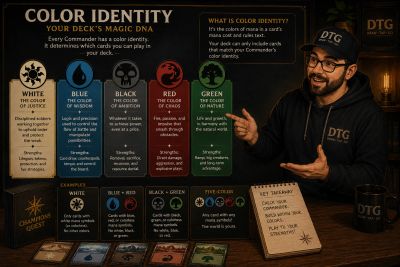
One of the most important parts of choosing a commander is understanding color identity.
Your commander determines which colors your deck can use.
Each color has its own personality and strengths.
White – Structure & Teamwork
White – Structure & Teamwork
White focuses on:
- Protection
- Small creature armies
- Lifegain
- Board control
White is good for:
- Organized strategies
- Defensive gameplay
- Team-style synergy
Blue – Knowledge & Control
Blue focuses on:
- Card draw
- Counterspells
- Manipulation
- Clever interactions
Blue rewards:
- Patience
- Planning
- Timing
Blue can be powerful, but sometimes overwhelming for brand new players.
Black – Sacrifice & Ambition
Black focuses on:
- Graveyards
- Sacrifice effects
- Resource trading
- Powerful removal
Black often feels:
- Risky
- Explosive
- Aggressive
Red – Chaos & Aggression
Red focuses on:
- Fast damage
- Aggressive creatures
- Direct burn spells
- Explosive turns
Red is one of the easiest colors for beginners to understand because it encourages proactive gameplay.
Green – Ramp & Big Creatures
Green focuses on:
- Mana ramp
- Large creatures
- Natural growth
- Creature-based gameplay
Green is one of the best beginner colors because it helps:
- Fix mana problems
- Cast big spells faster
- Recover from mistakes
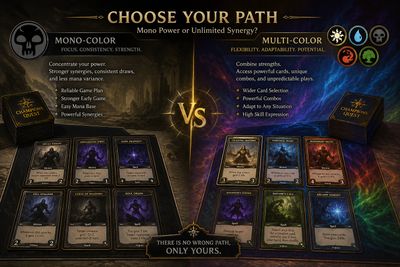
Mono-Color vs Multi-Color
Mono-Color Decks
Mono-color decks are often the easiest starting point.
Why?
Because:
- Mana bases are simpler
- Deckbuilding is easier
- You learn one color deeply first
Mono-red and mono-green are especially beginner friendly.
Two-Color Decks
Two-color decks are often the sweet spot for beginners.
You gain:
- More card variety
- More flexibility
- More strategy options
Without making the deck overly complicated.
A lot of the best beginner commanders are two-color decks.
Three+ Color Decks
These decks can be extremely fun…
…but they’re usually harder for brand new players.
More colors means:
- More complicated mana
- More deckbuilding decisions
- More expensive land bases
- More opportunities for mistakes
They’re often better once you’ve played several games already.
Choose a Commander That Helps You Learn
Your first commander should:
- Encourage interaction
- Have a clear strategy
- Recover from mistakes reasonably well
- Feel rewarding to pilot
You don’t want a deck where:
- Every decision is hyper-complex
- One mistake ruins the game
- You constantly forget triggers
- The strategy feels confusing
A good beginner commander teaches you how Commander works naturally while still being exciting.
It’s Okay if Your First Deck Isn’t Perfect
This is important.
Almost nobody keeps their very first Commander deck unchanged forever.
Commander players constantly:
- Upgrade decks
- Swap cards
- Change strategies
- Build entirely new decks
Your first commander is not a lifelong commitment.
It’s your starting point.
The goal is simply to:
- Learn the format
- Discover what you enjoy
- Gain experience
- Have fun at the table
Over time, your tastes will evolve naturally.
And honestly?
That evolution is one of the best parts of Commander.
The Best Beginner Commanders Are Usually…
The best beginner commanders tend to be:
- Straightforward
- Consistent
- Flexible
- Forgiving
- Fun even when losing
A commander that lets you actually play the game is far more valuable than one that wins occasionally but leaves you confused the rest of the time.
Because at the end of the day…
Commander isn’t just about winning.
It’s about building stories, memorable moments, and finding the kind of gameplay that makes you excited to shuffle up for the next game.